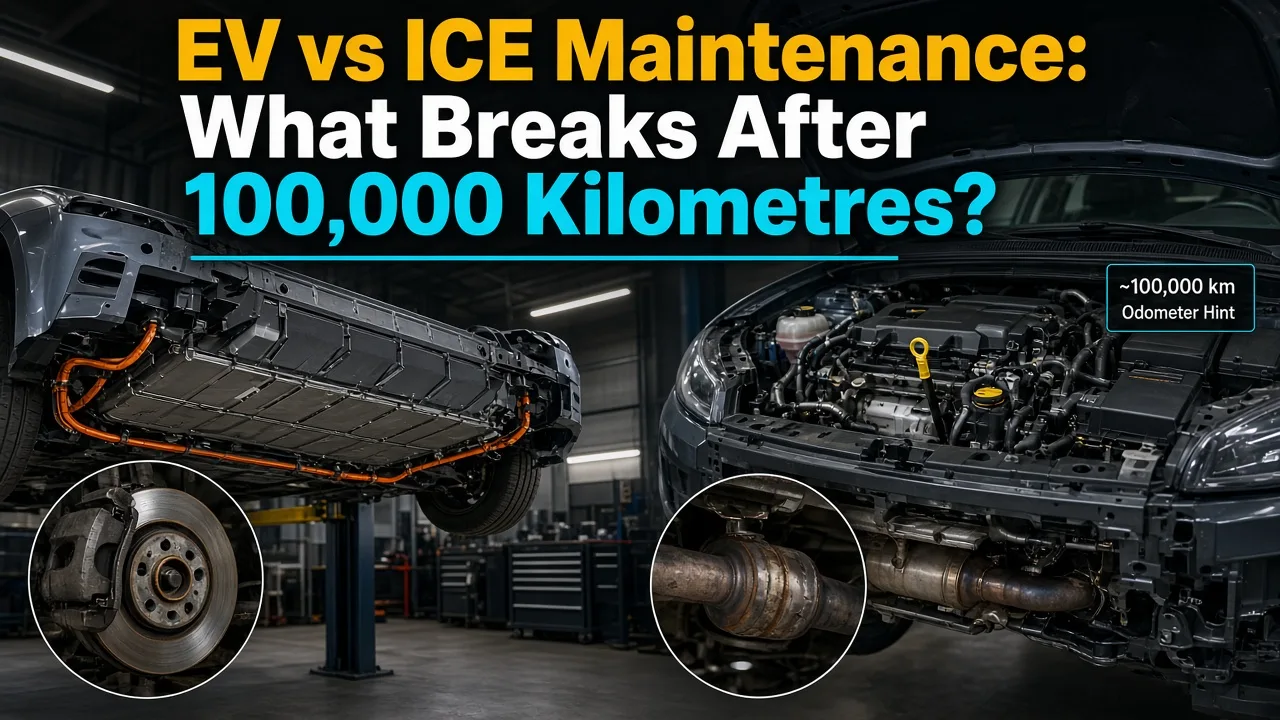
Crossing the 100,000-kilometre mark is a defining moment for any vehicle. For decades, reaching six figures on the odometer meant preparing your wallet for timing belt replacements, spark plug swaps, transmission fluid flushes, and an ever-growing list of mechanical squeaks.
Electric vehicles were widely touted as zero-maintenance machines that would render traditional mechanics obsolete. While EVs eliminate hundreds of moving internal combustion engine parts, reaching 100,000 km in an electric car brings its own unique wear items and service milestones. Here is an honest breakdown of what actually breaks, wears out, or needs servicing on both platforms once you cross six figures.
What Breaks on an ICE Vehicle at 100,000 Kilometres?
Internal combustion engine (ICE) vehicles rely on thousands of moving parts subjected to extreme heat, friction, and explosive forces. By the time an ICE car hits 100,000 km, several core mechanical components are near the end of their factory service life.
Critical Engine and Powertrain Wear
- Timing Belts and Water Pumps: Many petrol and diesel engines rely on a rubber timing belt to synchronize the crankshaft and camshafts. Most manufacturers recommend replacing the timing belt between 90,000 km and 120,000 km. Because the water pump is usually driven by the same belt, mechanics replace both simultaneously. Snapping a timing belt can destroy an engine, leading to repair bills upwards of $3,000 or ₹2,500,000.
- Ignition Components: Spark plugs and ignition coils degrade over tens of millions of firings. Aged plugs lead to misfires, reduced fuel economy, and potential damage to the catalytic converter. Replacing iridium spark plugs and set coils typically costs between $250 and $600 (₹20,000 to ₹50,000).
- Fuel and Exhaust Systems: Fuel injectors accumulate carbon deposits, oxygen sensors slow down, and exhaust hangers corrode. Catalytic converters also begin to efficiency-fault on poorly maintained cars.
Major Fluid Changes
By 100,000 km, an ICE vehicle has undergone 10 to 15 engine oil changes. However, this is also the interval where deeper fluid maintenance is due:
- Automatic or dual-clutch transmission fluid replacement
- Differential and transfer case gear oil changes
- Radiator coolant flushing to prevent internal corrosion
- Power steering fluid service (on hydraulic systems)
What Degrades on an EV at 100,000 Kilometres?
EVs do not have engine oil, spark plugs, alternators, starter motors, timing belts, or multi-speed gearboxes. However, operating a heavy battery on wheels presents a different set of maintenance demands.
Suspension and Steering Strain
Lithium-ion battery packs add significant mass. A midsize electric SUV often weighs 300 kg to 500 kg more than a comparable petrol crossover. This constant weight accelerates wear on chassis components:
- Suspension Bushings and Control Arms: Rubber bushings crack and tear under heavy cornering loads, causing clunks over bumps.
- Shock Absorbers and Struts: Dampers lose their rebound firmness earlier on EVs, degrading ride comfort and tire contact with the road.
- Tie Rod Ends and Ball Joints: Instant motor torque places additional shear force on front suspension connections.
Tire Wear and Alignment Issues
EVs are notorious for consuming tires faster than ICE cars. The combination of instant electric torque and higher vehicle mass wears tread down quickly. By 100,000 km, an ICE owner might be on their second set of tires, while an EV owner is frequently buying their third set. Replacing a full set of EV-rated low-rolling-resistance tires ranges from $800 to $1,400 (₹65,000 to ₹1,15,000).
Battery Health and Degradation
The standard concern for high-mileage EV owners is battery capacity loss. Modern liquid-cooled battery packs typically lose 8% to 12% of total usable capacity over 100,000 km. If an EV originally delivered 420 km of real-world range, it will likely yield around 370 km at six figures. Total pack failure at this mileage is rare, but capacity drop is permanent.
Common Ground: Brakes, Fluids, and Cabin Comfort
Both vehicle types share standard chassis components, though they experience wear differently:
Brake Systems: The Surprising Winner
Thanks to regenerative braking, an EV uses physical hydraulic brakes far less often. Electric cars convert kinetic energy into electricity, taking up to 80% of the stopping load. As a result, EV brake pads and rotors can easily last past 120,000 km.
In contrast, an ICE car usually requires two to three sets of front brake pads and at least one rotor replacement by 100,000 km. However, EV brake calipers can seize from disuse in regions that salt roads in winter, requiring routine slider lubrication.
Cabin and Thermal Maintenance
- Brake Fluid: Both platforms require fresh brake fluid every 2 to 3 years or 40,000 km to remove absorbed moisture.
- Coolant Loops: EVs use complex thermal loops to regulate battery temperatures. Replacing battery coolant around 100,000 km is critical to prevent thermal throttling and protect battery life.
- Cabin Air Filters: Both vehicle types need air filter replacements every 15,000 to 30,000 km to protect occupants from dust and PM2.5 particles.
Comparing 100,000 km Service Costs
Here is how typical cumulative maintenance and expected 100,000-km service items compare between a standard midsize ICE crossover and an equivalent EV:
| Service Category | ICE Vehicle (Petrol/Diesel) | Electric Vehicle (EV) |
|---|---|---|
| Powertrain Maintenance | Oil, spark plugs, timing belt, transmission fluid (~$2,200 / ₹1,80,000) | Reduction gear fluid check, software updates (~$300 / ₹25,000) |
| Brake System Wear | 2-3 pad sets, 1-2 rotor sets (~$900 / ₹75,000) | 0-1 pad set, caliper servicing (~$250 / ₹20,000) |
| Tire Rotations & Replacements | 1-2 replacement sets (~$1,200 / ₹1,00,000) | 2-3 replacement sets (~$2,000 / ₹1,65,000) |
| Suspension Wear | Moderate bushing & shock wear (~$600 / ₹50,000) | Higher bushing & damper wear (~$900 / ₹75,000) |
| Thermal Systems | Radiator flush, thermostat (~$300 / ₹25,000) | Dedicated battery coolant flush (~$450 / ₹37,000) |
| Estimated Total 100k Costs | ~$5,200 / ₹4,30,000 | ~$3,900 / ₹3,22,000 |
Out-of-Warranty Considerations
Most mainstream car manufacturers offer standard vehicle warranties up to 3 years or 100,000 km, while EV battery and drivetrain warranties typically extend to 8 years or 160,000 km.
Crossing 100,000 km means your ICE car is usually completely out of bumper-to-bumper warranty. If an alternator fails, a turbocharger leaks oil, or a fuel pump stops working, you pay out of pocket. Fortunately, independent mechanics widely understand ICE repairs, keeping labor rates competitive.
For EVs, while the high-voltage battery and drive motor remain covered for longer, out-of-warranty repairs on items like onboard chargers, inverter control units, or air conditioning heat pumps can be expensive. Independent repair networks for EVs are growing, but main dealerships still handle a large portion of complex electronic fixes.
Practical Steps for High-Mileage Drivers
If you plan to run your vehicle past 100,000 km, a proactive maintenance approach pays off:
- For ICE Owners: Do not skip timing belt and transmission fluid service intervals. Mechanical preventive care prevents catastrophic engine failure.
- For EV Owners: Rotate tires every 8,000 to 10,000 km to ensure even tread wear across all four wheels. Schedule periodic suspension inspections to catch worn control arm bushings before they ruin tire alignment.
- For All Drivers: Change brake fluid on schedule and inspect rubber brake hoses and steering rack boots for cracks.
Wrapping Up
Reaching 100,000 kilometres on an ICE car requires consistent preventive maintenance across dozens of engine and exhaust components. On an EV, mechanical powertrain headaches vanish, replaced by routine tire management, suspension care, and simple thermal system checks.
While electric vehicles save money on overall routine servicing and brake wear, their extra weight demands more attention to chassis components and tires. Knowing what wears out on each platform lets you budget accurately and keep your car running reliably for its next 100,000 kilometres.